




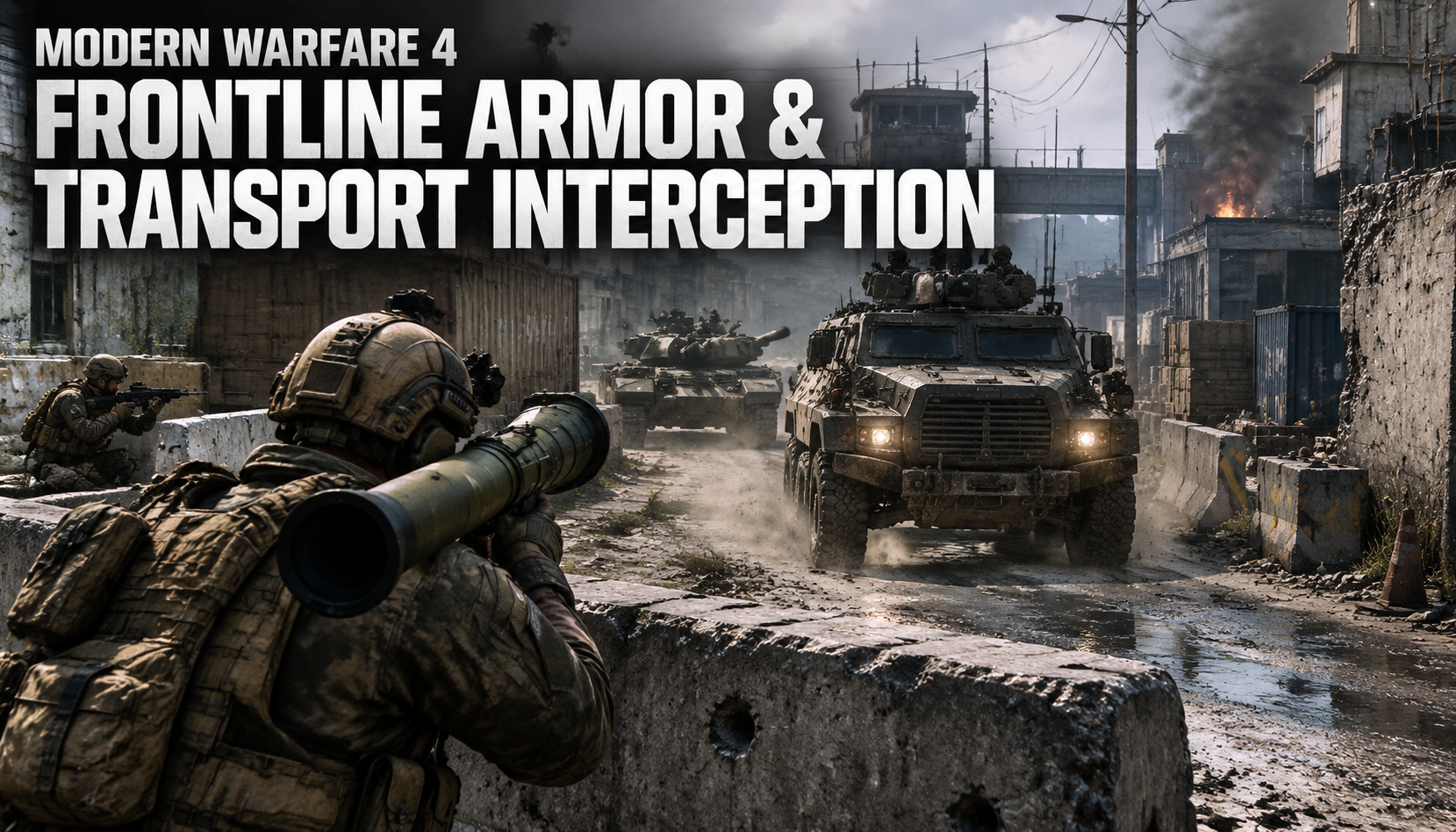
Modern Warfare 4’s large-scale combat puts infantry, vehicles, objectives, and reinforcement routes on the same battlefield. For players preparing for an Invasion-style fight, the key is learning how to stop armor and transports before they reach the active frontline. An MW4 Bot Lobby may be useful in a different gameplay context, but large-scale objective play demands route prediction, anti-vehicle positioning, and coordinated pressure rather than simply chasing eliminations.
MW4 has not yet established a dedicated Invasion ruleset equivalent to the versions seen in previous Modern Warfare titles. The confirmed large-scale framework is Ground War: Combat Outpost, a 24v24 mode tested on Imjin Farmlands and Wolves Stadium. Its infantry-and-vehicle combat provides the most useful foundation for learning frontline armor control and transport interception before launch.
How the Frontline Forms in Combat Outpost
Combat Outpost expands objective control across a much larger battlefield. Capturing an Outpost earns points, but more importantly, the captured position becomes another spawn location for your team. That means every successful capture can physically move friendly reinforcements closer to the next fight.
Teams can also Reinforce controlled Outposts to earn escalating battlefield support. Confirmed rewards include Local UAV coverage, a JLTV airdrop, and a Light Tank delivered to Headquarters.
This creates a simple frontline cycle:
- Capture an Outpost to gain territory and another spawn position.
- Hold the area instead of immediately abandoning it.
- Reinforce the position to build stronger team support.
- Watch the connecting routes for incoming infantry and vehicles.
- Use earned vehicle support to pressure the next contested area.
The frontline therefore isn’t a fixed line on the map. It shifts as teams gain and lose spawn positions, allowing one successful objective push to change where the next major engagement develops.
Stop Transports Before the Dismount
The worst time to intercept an enemy transport is after it reaches the objective. By then, passengers can dismount into nearby cover and turn a single vehicle target into several separate infantry threats.
Instead, look for terrain that restricts vehicle movement. Roads, bridges, tunnels, narrow streets, exposed crossings, and entrances between major areas are natural interception points.
Transport Interception Sequence
Spot the destination. Identify which Outpost or frontline position the enemy is likely to attack.
Read the route. Find the fastest vehicle lanes connecting enemy-controlled ground to that objective.
Set up off the road. Use solid cover instead of standing directly in the vehicle’s path.
Wait for commitment. Attacking too early gives the driver more time to reverse or choose another route.
Force the dismount. Destroying the transport is ideal, but making passengers leave the vehicle early is already valuable.
Change position. Once you fire, assume both the crew and nearby infantry know where you are.
A transport forced to unload away from the objective loses much of its mobility advantage. The passengers now have to finish the approach on foot, giving defenders more time to establish angles, reinforce the Outpost, or prepare for the infantry push.
Build an Anti-Armor Position, Not Just an Anti-Armor Loadout
Carrying a Launcher doesn’t automatically make a player effective against vehicles. Positioning determines whether you can land a shot without immediately being exposed to return fire.
Look for a firing position that provides three things: visibility over a likely vehicle lane, solid cover after firing, and another route you can use to relocate.
Avoid repeated peeks from the same angle. Once a vehicle crew knows your position, another shot from the same window, rooftop edge, or roadside object becomes much easier to punish.
Enemy infantry matters just as much as the vehicle itself. Tanks and transports operating near friendly infantry can force anti-vehicle players to divide their attention between the vehicle and nearby rifle threats.
Imjin Farmlands Favors Early Vehicle Detection
Imjin Farmlands combines open fields, waterways, agricultural structures, roads, rail lines, and a large mill. Its relatively flat terrain supports long sightlines and gives vehicles room to maneuver.
It also makes vehicles easier to identify before they reach an Outpost. Official Beta guidance specifically recommends bringing a Launcher when enemy vehicles are active and using the flat terrain to land anti-vehicle shots.
| Battlefield Situation | Response |
| Armor crossing open ground | Engage from protected range |
| Transport entering a narrow road | Hold the route and wait for commitment |
| Vehicle approaching an Outpost | Prioritize it before distant armor |
| Friendly tank pushing forward | Clear nearby infantry threats |
| Enemy armor retreats | Reposition instead of chasing across open ground |
The mill provides valuable elevation for observing movement across the surrounding area. Use high ground for information as much as for shooting; a position that reveals an incoming transport early can give your entire squad time to prepare.
Wolves Stadium Rewards Side Angles
Wolves Stadium changes the vehicle fight. Dense streets, multi-story buildings, transit infrastructure, tunnels, rooftops, and surrounding hills create more protected routes for infantry and more restrictions on vehicle movement.
Use those restrictions against armor. Instead of fighting from the middle of a street, move through structures and vertical routes to attack from angles the driver has difficulty watching.
Ascenders, ladders, and pipes provide additional ways to reach elevated positions. These routes are useful for spotting traffic below, but avoid rooftops that leave you exposed with no protected exit.
The amphitheater is particularly useful as an example of terrain vehicles have difficulty penetrating. When fighting around areas like this, infantry can hold protected ground while anti-vehicle players monitor the streets and approaches outside.
Infantry Should Screen Friendly Armor
Friendly tanks shouldn’t be treated as independent assault units. A vehicle concentrating on targets ahead can miss enemies moving through buildings, rooftops, side streets, or other nearby cover.
Infantry should move close enough to clear these threats without clustering directly around the vehicle. Watch for enemy Launcher users, players trying to flank the vehicle, and infantry using elevation to create firing angles.
Armor can then return the support by controlling exposed approaches and helping infantry cross open areas.
Squad Priority
- Infantry clears immediate close-range threats.
- Armor pressures exposed enemy positions.
- Anti-vehicle players watch likely enemy transport routes.
- Objective players secure or Reinforce the Outpost.
- The squad shifts forward only when the next route is reasonably controlled.
This is especially important with vehicles earned through Combat Outpost reinforcement. Driving a Light Tank directly into unsupported enemy territory can throw away an advantage the team earned through objective control.
Disruption Can Be More Valuable Than Destruction
You don’t always need the final vehicle kill for an interception to work. A tank forced behind cover temporarily stops controlling its firing lane. A transport forced to turn around cannot deliver passengers on schedule.
Think about the effect on the objective rather than only the destruction notification.
If damaging a vehicle gives teammates enough time to finish a capture or stabilize a forward spawn, the engagement has already produced value. This is why firing at every distant vehicle as soon as it appears can be inefficient; sometimes the stronger play is waiting until it enters terrain where retreating becomes difficult.
Read Movement Before Choosing Your Next Target
Large-scale modes punish tunnel vision. Watch where teammates are concentrated, where friendly players are repeatedly disappearing, and where enemy vehicles are entering the active battle.
Local UAV coverage earned through Combat Outpost reinforcement can further improve battlefield awareness. Use that information to identify threats connected to the objective rather than chasing isolated contacts far from the frontline.
Prioritize vehicles based on their immediate effect on the objective. Start with armor directly threatening an active Outpost. Next, focus on loaded transports approaching the frontline, followed by vehicles blocking an important infantry route. Distant armor with little influence on the current objective should normally be your lowest priority.
Following this order keeps anti-vehicle pressure connected to the match objective instead of turning vehicle hunting into a distraction.
Prepare for MW4 Large-Scale Battles
Modern Warfare 4 launches on October 23, so players should avoid assuming that every AI, scoring, spawn, and reinforcement rule from older Invasion modes will return unchanged. Combat Outpost currently provides the clearest confirmed model: 24v24 combat, infantry and vehicles, forward Outpost spawning, Reinforce objectives, and team rewards that escalate into vehicle support.
Account-level extras such as CoD MW4 Redeem Codes should be treated separately from this battlefield preparation. For large-scale matches, knowing a transport corridor, identifying a safe Launcher position, or protecting a friendly tank will matter more than anything that doesn’t directly change how your squad controls the frontline.
Key Takeaway
Treat frontline armor and transport interception as an objective-control problem rather than a vehicle-hunting minigame. Capture and Reinforce Outposts, predict the roads feeding the next fight, force transports to unload before reaching useful cover, and relocate after attacking armor. When your own vehicles arrive, pair them with infantry instead of sending them forward alone; that combined pressure is the safest way to turn one controlled Outpost into the next successful push.